
Issue 35: A Closer Look at Cardiac Ablation: The Commonwealth’s Highest-Spending Outpatient Procedure

HPC DataPoints is a series of online briefs that spotlight new research and data findings relevant to the HPC’s mission. A printable version is also available.
Background
Previous research by the HPC has found that hospital outpatient spending represents the largest contributor to commercial health care spending growth in Massachusetts, accounting for nearly 40% of commercial spending growth from 2022 to 2024.[1] Among the major categories of outpatient care, spending on outpatient surgeries accounts for the most growth and has increased almost 10% each year from 2019 to 2024. This growth reflects a number of factors including rising prices, a shift from hospital inpatient to hospital outpatient settings for some surgeries (such as knee replacements), and growth in volume of others. One example of the latter category is cardiac ablation, the highest-cost outpatient surgery or procedure in Massachusetts in 2024, which is explored further in this issue of DataPoints.
Cardiac ablation is an intensive medical intervention that is primarily used to address a condition known as atrial fibrillation, a type of irregular heartbeat.[2] Many people with atrial fibrillation experience no symptoms but, for some, the condition can cause shortness of breath and fatigue, reduced quality of life, cardiac arrest, stroke, and even death. Currently, treatment approaches range from lifestyle modifications to prescription drugs to cardiac ablation. Cardiac ablation is a surgical procedure to scar the heart tissue believed to be the cause of the uneven heart rhythm. Recently, there have been notable advancements in the treatment approaches and the technology used in these procedures, including the use of electrical pulses (rather than hot or cold thermal energy) and the use of 3-D image mapping of the heart to help guide precise treatment of the targeted tissue.
Cardiac ablation is performed primarily in a hospital outpatient setting.[3] Although CMS approved the performance of cardiac ablation procedures in ambulatory surgical centers (ASCs) beginning in January 2026, Massachusetts currently does not permit cardiac ablations in freestanding ASCs.[4]
The largest comparative clinical trial found that ablation reduced the occurrence of persistent atrial fibrillation more than drug therapy and improved patient quality of life but did not significantly improve other outcomes such as stroke compared to drug therapy.[5] Some patients experience recurrence and may have more than one ablation procedure.[6],[7]
This issue of DataPoints explores trends in the number of these procedures and the prices in Massachusetts. This analysis included cardiac ablation treatments for Massachusetts residents on either commercial insurance or Medicare Advantage using data from the Center for Health Information and Analysis (CHIA)’s Massachusetts All-Payer Claims Database January 2019 through October 2025.
Trend in number of procedures performed
The number of such procedures performed in Massachusetts has been increasing rapidly over the last several years (Exhibit 1). The total number of ablation procedures nearly doubled among the commercially-insured population from an estimated 2,215 in 2019 to 4,155 in 2025, and more than doubled among Massachusetts Medicare beneficiaries (from 2,028 to 5,370). This increase may be partly driven by the fact that the American College of Cardiology recommended cardiac ablation as a first line treatment for atrial fibrillation over drug therapy for certain groups of patients in 2023 and because newer technology allows for greater patient throughput and potentially greater profitability.[8],[9] In addition, the ability to detect atrial fibrillation, even in cases that are asymptomatic to the patient, is also increasing with greater provision of implantable and wearable devices.[10]
Exhibit 1. Estimated Volume of Cardiac Ablation procedures in Massachusetts, 2019-2025
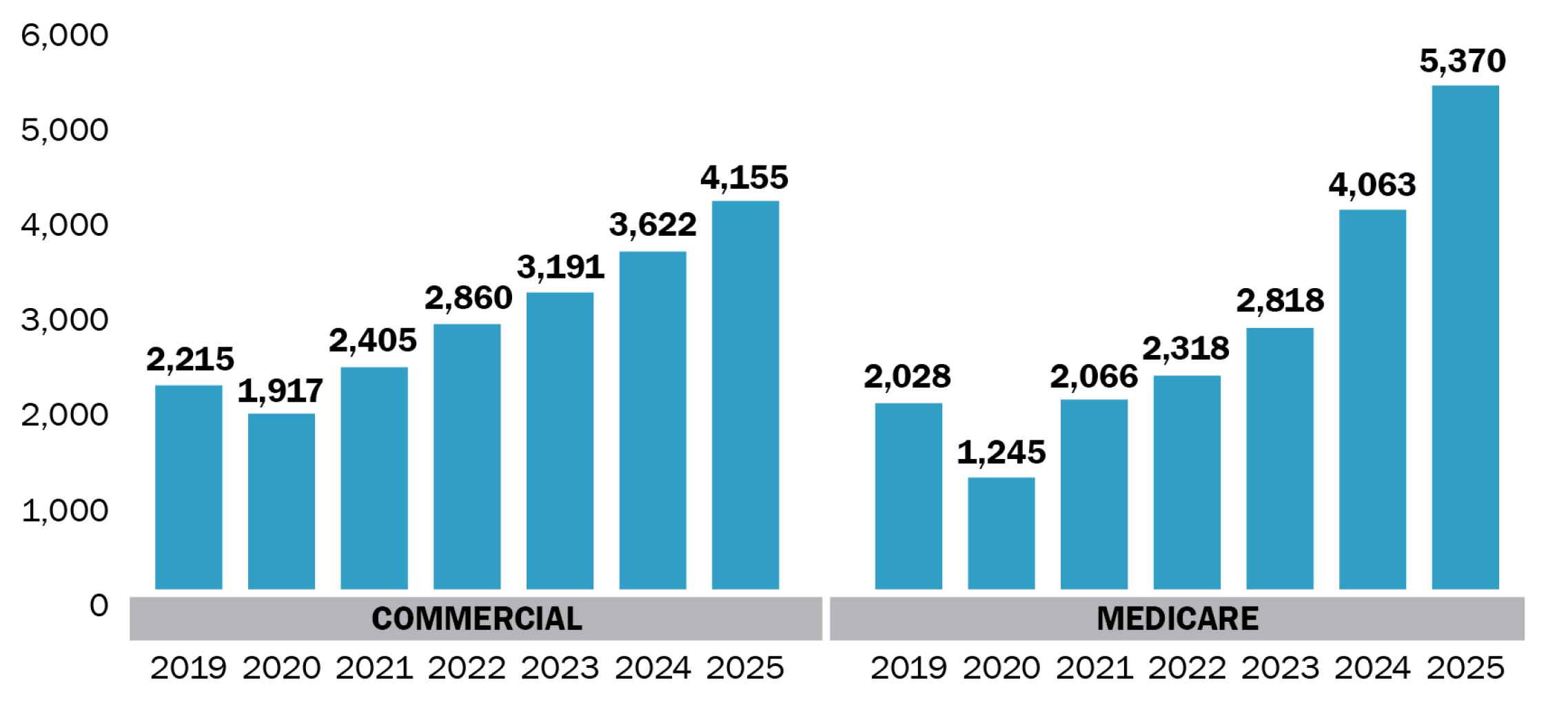
Notes: Ablations were identified in the Massachusetts all-payer claims database using CPT codes 93650, 93653, 93654, and 93656 with commercial members limited to BCBS, Harvard Pilgrim, Tufts, United, Elevance, Health New England and payers represented in the Medicare Advantage population. All claim lines were collapsed at the level of a person-procedure code. The estimated number of ablations for the Massachusetts population was extrapolated assuming that the members not in the e-APCD were representative of the total commercial population and the Medicare Fee-For-Service population. The Massachusetts e-APCD is estimated to cover about 35% of the commercially insured Massachusetts population. The Massachusetts Medicare Advantage population makes up about 1/3 of the total Massachusetts Medicare population. Note, data shown for 2025 represents an extrapolation from the first 10 months of the year for which data was available.
Source: HPC Analysis of the Center for Health Information & Analysis enhanced All-Payer Claims Data Base (eAPCD), January 2019-October 2025
Prices and spending on cardiac ablation
As of 2024, cardiac ablation was the highest-spending outpatient surgery or procedure in Massachusetts (Exhibit 2).
Exhibit 2. Volume, spending and average payment (price) per procedure for the top ten outpatient surgeries or procedures by total spending, 2024.
Notes: Data include procedures and surgeries performed in all outpatient settings including ambulatory surgery centers. Volume and total spending based on extrapolation to full Massachusetts commercial market. Prices include all facility and professional claim lines with the same date of service as the noted procedure or surgery for a given member. Categorization is based on AHRQ’s Clinical Classification software. Some broad, nonspecific groupings of items were excluded from the table.
Source: HPC analysis of Massachusetts All-Payer Claims Database, v2024, 2024.
The average cardiac ablation price in Massachusetts was just over $50,000 per procedure, including payments for anesthesia, supplies, imaging and other procedures that were provided to the patient on the day of the ablation procedure. This price exceeded the amount paid for all but the most expensive 15% of inpatient stays in Massachusetts that year.[11] Associated spending before and after the procedure (including services such as labs, office visits, and imaging) averaged $1,600 per patient, leading to average spending of $52,000 per procedure and a total of $188 million spent on the procedures in the Massachusetts commercial market in 2024.
Ablation surgery prices for private commercial plans, like most services in Massachusetts paid by commercial insurers, varied extensively (Exhibit 3) based on which hospital performed the procedure (and to a lesser extent, which private commercial insurer paid for it). Prices ranged from $21,060 among the lowest-priced 1% of procedures to $116,386 for the highest-priced 1% of procedures. Medicare paid approximately $26,000 for the procedure in 2024. A 2022 study on the cost-effectiveness of cardiac ablation compared to drug therapy found that the procedure becomes ‘economically unattractive’ at a procedure price of more than $42,500 and ‘low value’ at a price exceeding $60,000.[12]
Exhibit 3. Variation in Commercial Prices for Cardiac Ablation, 2024
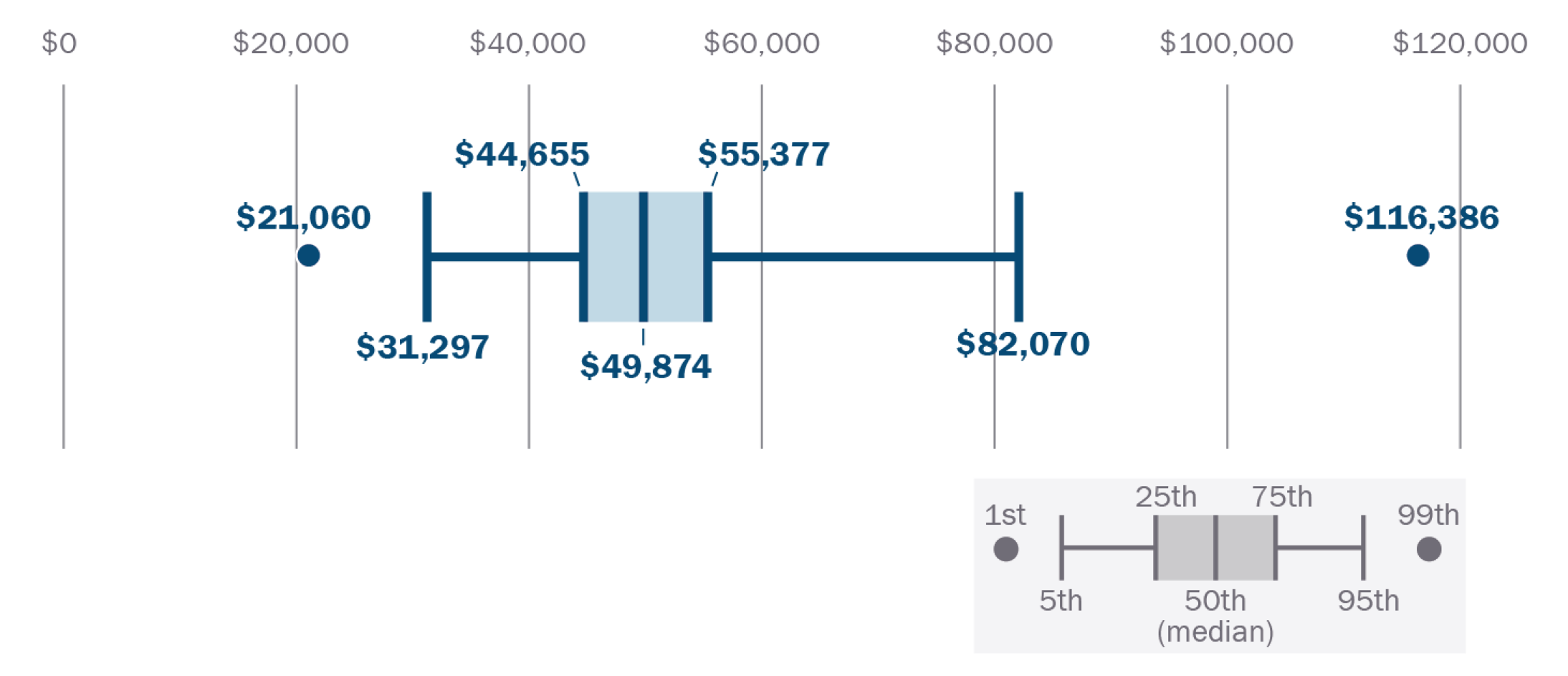
Notes: Ablations were identified using CPT codes 93650, 93653, 93654, and 93656. Estimated ablation price includes all hospital outpatient and professional claim lines with the same date of service as outpatient ablation for a given member. Due to some additional exclusions, prices may not exactly match those shown in Exhibit 2.
Sources: HPC Analysis of Massachusetts All-Payer Claims Data Base v2024, 2024.
Conclusion
Cardiac ablation is the highest-cost outpatient surgery or procedure in Massachusetts and its use is growing rapidly. As the use of the procedure grows and technology and treatment approaches evolve, continued study is warranted, including of its patient benefit, safety, and cost effectiveness.
[1] See Massachusetts Health Policy Commission Benchmark Hearing, April 1, 2026: https://masshpc.gov/sites/default/files/2026-04/20260401_Benchmark_Presentation.pdf
[2] In Massachusetts in 2024, roughly three-quarters of patients undergoing cardiac ablation procedures had a diagnosis of atrial fibrillation.
[3] There is a small number of procedures performed as part of a hospital inpatient stay - they are not included in this analysis.
[4] As of January 1, 2026, CMS approved cardiac ablation for performance in ambulatory surgical centers. In Massachusetts, cardiac ablation falls under electrophysiology services which are only permitted in hospital settings. See 105 CMS 130.900.
[5] The trial reduced the occurrence of persistent atrial fibrillation from 57% of patients at the start of the trial to 16% among the ablation group versus 26% among the drug therapy group four years later. See Packer, Douglas L., et al. "Effect of catheter ablation vs antiarrhythmic drug therapy on mortality, stroke, bleeding, and cardiac arrest among patients with atrial fibrillation: the CABANA randomized clinical trial."Jama 321.13 (2019): 1261-1274. A more recent trial found a reduction in asymptomatic fibrillation but no impact on quality-of-life measures, see Wazni, Oussama M., et al. "Pulsed field ablation as initial therapy for persistent atrial fibrillation."New England Journal of Medicine 394.24 (2026): 2407-2418.
[6] Sanchez-Somonte, Paula, et al. "Incremental efficacy for repeat ablation procedures for catheter ablation of atrial fibrillation: 5-year follow-up."JACC: Advances 3.9 Part 1 (2024): 101200.
[7] Benali, Karim, et al. "Procedure-related complications of catheter ablation for atrial fibrillation." Journal of the American College of Cardiology 81.21 (2023): 2089-2099.
[8] Modern Healthcare (Jan 26, 2026). “Hospitals are embracing pulsed field ablation. Here’s why.”
[9] Wiggins, Barbara S., Morgane Cibotti-Sun, and Mykela M. Moore. "2023 atrial fibrillation guideline-at-a-glance."Journal of the American College of Cardiology 83.1 (2024): 280-284.
[10] El-Medany, Ahmed. "Device-Detected Atrial Fibrillation: Why Time-Based Thresholds Are No Longer Fit for Purpose."Journal of Clinical Medicine15.8 (2026): 2961. Note: there was an increase in the proportion of patients in the commercial claims data with any atrial fibrillation diagnosis from 2020 to 2024, but it is unclear if this increase represents increased detection or a biological phenomenon in the population.
[11] In other words, excluding maternity stays, 85% of full inpatient stays in Massachusetts in 2024 were paid less than this amount. The average length of stay for non-maternity stays in Massachusetts in 2025 was 4.7 days. The relatively high price paid for cardiac ablation by Medicare reflects the considerable time, equipment, and personnel cost involved in performing the procedure.
[12] See Chew, Derek S., et al. “Cost-effectiveness of catheter ablation versus antiarrhythmic drug therapy in atrial fibrillation: the CABANA randomized clinical trial.”Circulation 146.7 (2022): 535-547. Value assessment based on cardiology guidelines referenced in the article. Total episode costs derived from cost breakdowns included in the article. These costs include offsetting savings on prescription drugs of approximately $1,400 per patient receiving an ablation procedure ($8,100 versus $9,500) over the course of the five-year trial and follow-up period.