
Despite being one of the highest-value categories of care, primary care represents a declining share of health care spending in Massachusetts. Primary care in the Commonwealth is facing many challenges, for both providers and patients. Many patients face significant access barriers to receiving care, and residents of lower income communities are most likely to have no primary care use at all.
Although Massachusetts has the highest total physicians per capita, Massachusetts has the fifth lowest share of all physicians who work in primary care and few new physicians are going into primary care.
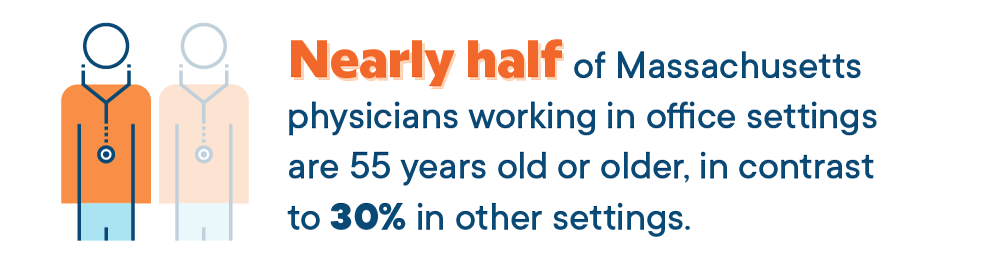
For providers, administrative burden makes the work of providing primary care increasingly unsustainable, and many experience burnout. Low payment rates for primary care, relative to specialty and hospital-based care, disincentivize new physicians from entering the field and disincentivize the health industry from prioritizing primary care. As a result, few physicians are going into primary care, and many report reducing their hours or exiting patient care, leaving larger patient panels for remaining providers.
Many patients face significant access barriers to receiving care, and residents of lower income communities are most likely to have no primary care use at all. In 2022, commercially-insured children living in low-income areas were three times more likely to have no primary care visits than children in the highest-income areas. In the Center for Health Information and Analysis (CHIA) 2026 Primary Care Dashboard, 30.1% of Massachusetts residents reported experiencing difficulty obtaining necessary primary care services in the past 12 months. Further, the percentage of residents reporting they had a preventive care visit in the past 12 months decreased from 81.3% in 2023 to 75.1% in 2025.
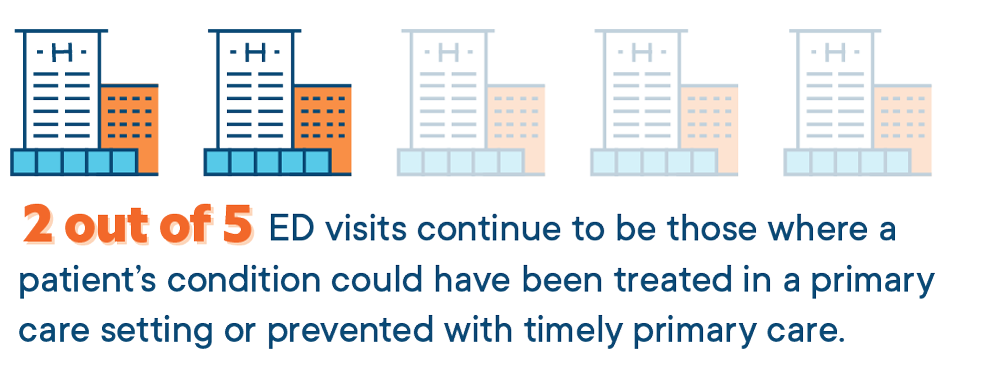
These challenges have downstream effects on the Commonwealth’s health care system and the health outcomes of its residents. The HPC found that in 2024, roughly 40% of emergency department visits continued to be those where a patient’s condition could have been treated in a primary care setting or prevented with timely primary care. The 2025 Massachusetts Health Insurance Survey found that 54.8% of individuals who visited the ED for a nonemergency condition sought care in that setting because they were unable to get an appointment at a doctor's office or clinic as soon as they needed.
Nurse practitioners and physician assistants are increasingly involved in primary care, but Massachusetts has been slow to integrate them into practice, and financial and job-quality considerations may lead them to opt for hospital-based or specialty careers. Community health centers – an essential source of primary care for patients who are medically underserved – are experiencing an exacerbated version of the trends and obstacles facing primary care across the Commonwealth.
The HPC has examined many of the challenges facing the primary care workforce in A Dire Diagnosis: The Declining Health of Primary Care in Massachusetts and the Urgent Need for Action.
Primary Care Access, Delivery, and Payment Task Force
In December 2024, the Massachusetts Legislature passed Chapter 343 of the Acts of 2024, An Act enhancing the market review process, which was signed into law by Governor Healey in January 2025. Section 80 established the Primary Care Access, Delivery, and Payment Task Force (PCTF) to examine the challenges affecting the essential primary care system in Massachusetts and develop policy solutions to stabilize and improve primary care access, delivery, and payment.
The 25-member task force was co-chaired by the Executive Office of Health and Human Services and the Massachusetts Health Policy Commission.
In September 2026, the task force issued a compendium of the recommendations they were charged to develop.